Our Health→Texas Hearing Institute - Pediatric Audiology Services in HoustonResourceCall Texas Hearing Institute →
Call Texas Hearing Institute
Take the next step — every action here is one tap away.
What this is
Houston clinic providing comprehensive hearing care and advanced solutions for children from birth to age 21 with hearing loss.
Skip to main content
Skip to footer
AUDIOLOGY OVERVIEW
Texas Hearing Institute provides the latest and most comprehensive diagnostic audiology services available with state-of-the-art equipment. Pediatric audiologists with doctoral degrees provide a family-centered, evidence-based early intervention approach to achieve optimal speech and language outcomes for children who are deaf and hard of hearing from birth to age 21. To enable children to maximize their hearing and receive the finest hearing care, our clinic is on the cutting edge of new, advanced technologies, which include hearing aids, osseointegrated devices, cochlear implants, and remote microphone solutions.
When hearing loss is detected, our pediatric audiologists provide unbiased counseling to inform families about their communication options. We support all communication modes within the Audiology Department. We work with families to understand the communication goals they have determined for their child and work together as a team to develop an individualized to achieve those goals. Texas Hearing Institute provides a full range of hearing aid, cochlear implant, osseointegrated devices, and remote microphone solutions.
Read full text
Our top priority is to help every child gain access to sound, so they can learn to listen, speak, and communicate. We do this by collaborating with speech-language pathologists, physicians, and educators to support your child’s hearing journey.
Hearing – How the Ear Works
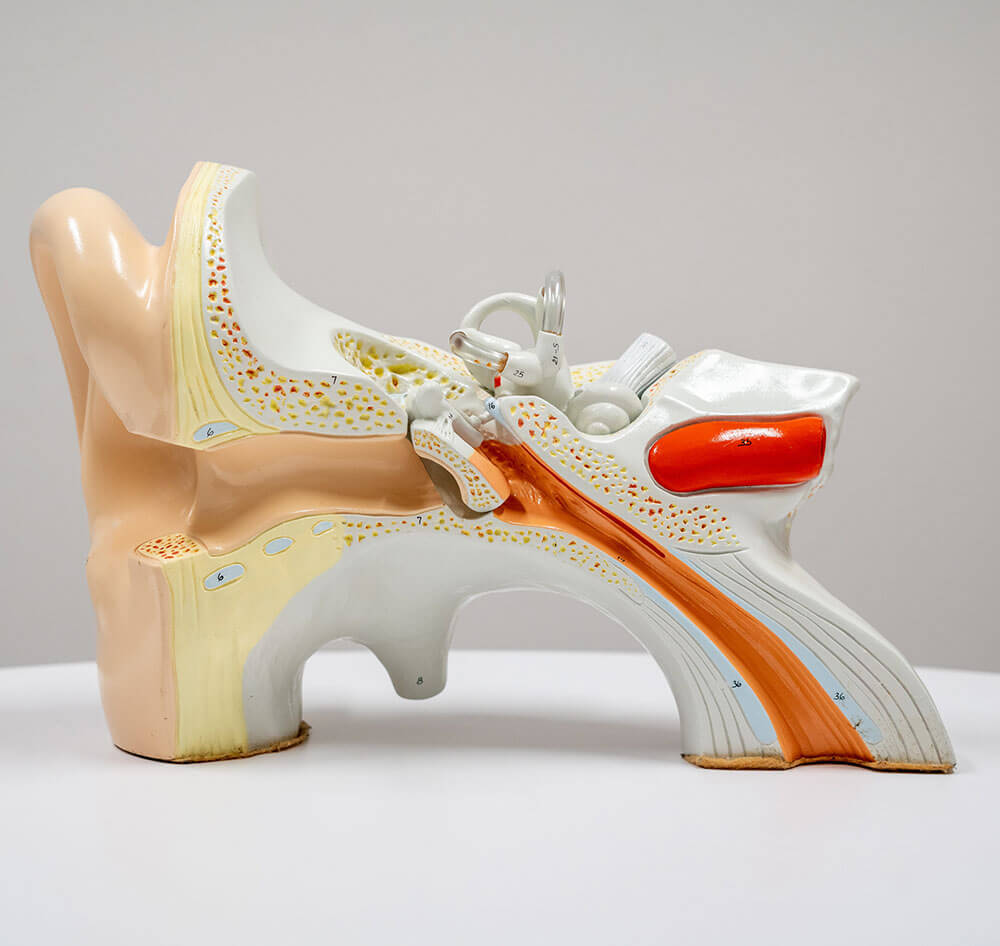
The fascinating conversion of waves of sound pressure into voices, music, and other everyday noises all occurs in our ears and brain. There are three components of our ears, each with a very basic purpose and function:
Outer Ear - This area acts as a funnel directing sounds to the ear drum.
Middle Ear - Here, sound is changed from sound pressure waves to mechanical energy through the vibrating of the ear drum. The tiny bones attached to the ear drum send it on to the inner ear.
Inner Ear - The fluid-filled labyrinth of the inner ear is where electrical nerve impulses send sounds to the brain for interpretation.
Sound is transformed into mechanical energy by the tympanic membrane. It is then transmitted through the ossicles to the inner ear, where it is changed again into hydraulic energy for transmission through the fluid-filled cochlea. The cochlea's hair cells are stimulated by the fluid waves and a neurochemical event takes place that excites the nerves of hearing. The physical characteristics of the original sound are preserved at every energy change along the way until this code becomes one the brain can recognize and process. The ears and the brain work together in a remarkable way to process neural events into the sense of hearing. In fact, we “hear” with our brain, not with our ears.
About Hearing Loss
Hearing and speech are essential tools of learning, playing, and developing social skills. Children learn to communicate by imitating sounds they hear from birth. If they have hearing loss that is undetected or untreated, they can miss much of the speech and language around them. This can result in delayed speech and language development, social problems, and/or academic difficulties.
Of every 1,000 births, two to three children are born with some degree of permanent hearing loss.
Every year in Texas, approximately 1,200 babies will be born with hearing loss.
More than 90% of children with diagnosed hearing loss are born to parents with typical hearing. About half of all children with hearing loss have no risk factors.
Children born with normal hearing can begin to have hearing problems as they grow older. These hearing problems can be temporary or permanent. It can occur due to infections, injuries, or exposure to very loud sounds. It is important for parents to continuously look for signs of hearing loss as their children grow up.
Signs of hearing loss may include the following:
Your baby:
does not startle to loud sounds appears to hear some sounds but not others does not turn toward sound after 6 months of age only turns toward you if they see you, and not when you call their name from behind
does not startle to loud sounds
appears to hear some sounds but not others
does not turn toward sound after 6 months of age
only turns toward you if they see you, and not when you call their name from behind
Your toddler or school-age child:
Has difficulty understanding what people are saying Speaks differently than other children her or his age Doesn't reply when you call his or her name Responds inappropriately to questions (misunderstands) Turns up the TV volume incredibly high or sits very close to the TV to hear Has problems academically, especially if these issues weren't present before Has speech or language delays or problems articulating things Watches others in order to imitate their actions, at home or in school Complains of ear pain, earaches, or noises Says "What?" or "Huh?" several times a day
Has difficulty understanding what people are saying
Speaks differently than other children her or his age
Doesn't reply when you call his or her name
Responds inappropriately to questions (misunderstands)
Turns up the TV volume incredibly high or sits very close to the TV to hear
Has problems academically, especially if these issues weren't present before
Has speech or language delays or problems articulating things
Watches others in order to imitate their actions, at home or in school
Complains of ear pain, earaches, or noises
Says "What?" or "Huh?" several times a day
You cannot understand your child’s speech
If any of these scenarios sound familiar, don't wait to act. Hearing loss has an enormous impact on childhood language development, and untreated hearing loss can also add to behavioral problems.
If your child is showing signs of hearing loss or not reaching the milestones on the communication checklist, please give us a call to schedule an appointment to talk about your concerns.
We can identify the type of hearing loss your child may have, diagnose how severe it is, and make recommendations based on your family’s communication goals.
Schedule An Appointment!
To learn more about our Audiology Department and its programs and services, click on the links below:
Pediatric Audiology Services
Newborn Hearing Screening and Intervention Hearing Tests Hearing Aids Bone Conduction Solutions Cochlear Implants Remote Microphone Technology Interpreting Earmolds and Swim Plugs
Newborn Hearing Screening and Intervention
Hearing Tests
Hearing Aids
Bone Conduction Solutions
Cochlear Implants
Remote Microphone Technology
Interpreting
Earmolds and Swim Plugs
Special Programs
Free Communications Options Counseling Financial Support Program for Hearing Aids Financial Support for Services Melinda Webb School Audiology
Free Communications Options Counseling
Financial Support Program for Hearing Aids
Financial Support for Services
Melinda Webb School Audiology
Community Outreach
Hearing Screening Hearing Loss Prevention
Hearing Screening
Hearing Loss Prevention
Externship
Frequently Asked Questions
Footer
CALENDAR OF EVENTS
Get a heads-up on upcoming special events and fun activities at Texas Hearing Institute in the coming weeks and months.
OUR BLOG
Learn more about new advances in the field of pediatric audiology, speech therapy, as well as news involving Texas Hearing Institute in our exclusive blog.
Texas Hearing Institute
Address:
3100 Shenandoah St. Houston, TX 77021-1042
Phone:
(713) 523-3633
Home
About Us
Services
Resources
Professionals
Ways to Give
Blog
Success Stories
Contact Us
Request an Appointment
Donation Form
Refer a Patient
Accessibility Statement
HIPAA Privacy Policy
Sitemap
At Texas Hearing Institute in Houston, TX, we provide audiology and speech therapy services for adults and children with hearing loss.
Key details
- Cost: Varies by service and insurance; contact clinic to discuss coverage and financial options
- Hours: Contact clinic directly for current appointment hours
- Who qualifies: Children and young adults from birth to age 21 who are deaf or hard of hearing
- Languages: Contact clinic to confirm available languages and interpreter support
- Documents needed: Insurance card, referral if required, prior hearing test results if available
Where it reaches
- Address
- 3100 Shenandoah St.
- Phone
- (713) 523-3633
Available across Houston.
Why it matters
Children with hearing loss need early intervention to develop speech and language. This Houston clinic serves kids birth–21 with advanced diagnostics and devices, helping families make informed choices so children can reach their full communication potential.
How to get this
- 1Start with the snapshot above to know what this is in a glance.
- 2Check the key details to see if it fits your situation.
- 3See if you qualify using the button above.
When you call, you can say: “Hi, I saw "Texas Hearing Institute - Pediatric Audiology Services in Houston" on Community Exchange and want to know how to take part.”
By the numbers
Led byTexas Hearing Institute
Counted from the Community Exchange connection graph.