Start with the plain guide. Open the deeper layers when you want the ecosystem around it.
IntensityNoticeRead, understand, orient.
StewardSchool / College
1Orgs
3Policies
9Links
First readWhat to know+
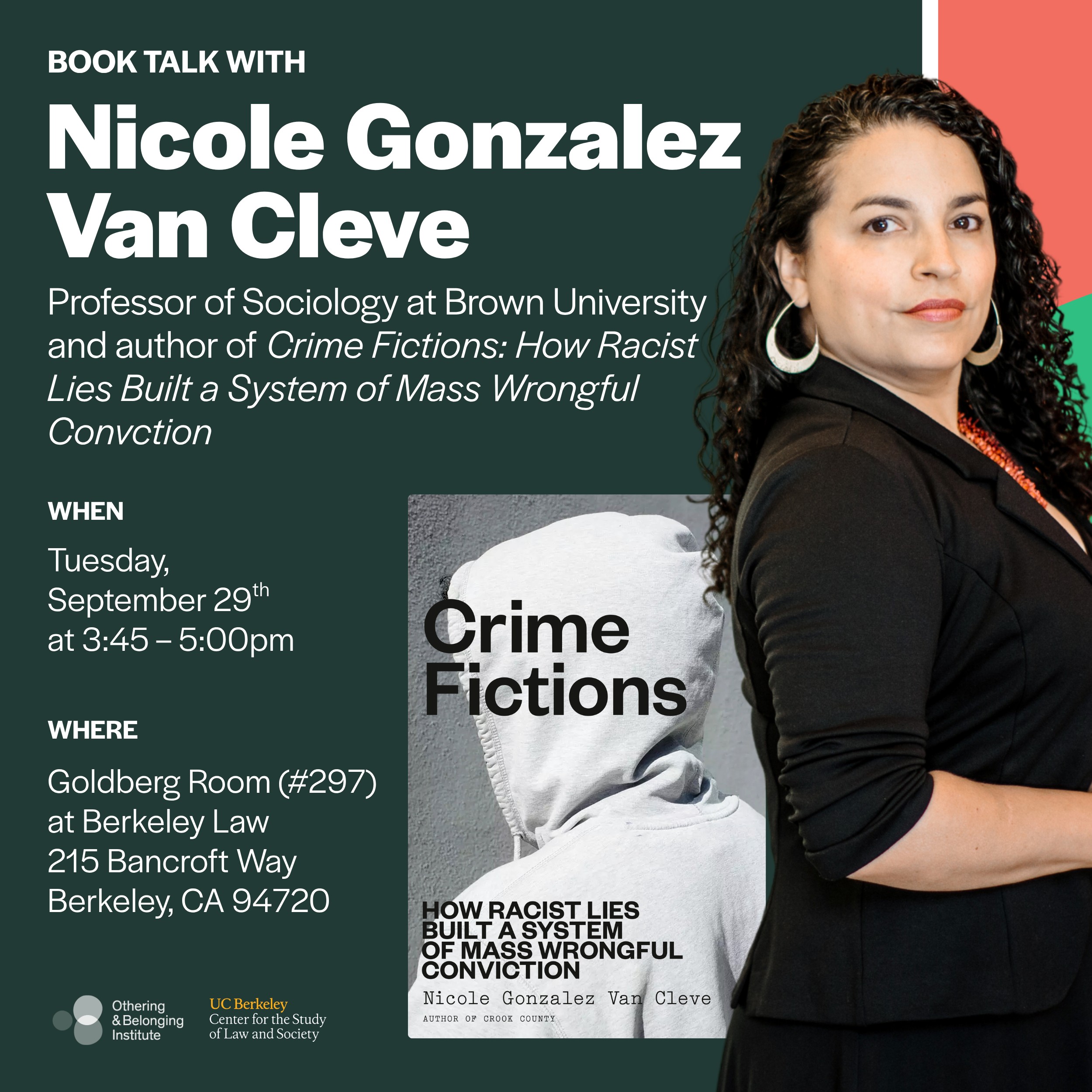
Topic: How racist lies and false evidence have caused wrongful convictions of innocent Black youthEvent Date: Tuesday, September 29thSource: Berkeley Law, co-sponsored by the Othering & Belonging InstituteCost: Free and open to the publicSpeaker: Dr. Nicole Gonzalez Van Cleve, sociology professor at Brown University
Next rungHow to step in+
Good first step: Act Register or learn more about the free Berkeley Law book talk
Search 'Nicole Gonzalez Van Cleve Berkeley Law book talk' to find registration details and attend or watch this important free event.
Time and placeWhere this sits+
Our CommunityOthering and Belonging Institute at UC Berkeley
Sociology professor Dr. Nicole Gonzalez Van Cleve spent years inside Chicago's Cook County courthouse — the largest criminal courthouse in the country — and found something troubling. Wrongful convictions of Black youth are not rare mistakes. They follow a clear, deliberate pattern. Her book, Crime Fictions: How Racist Lies Built a System of Mass Wrongful Conviction, lays out exactly how that pattern works.
Crime Fictions walks you through real cases, including Lee Hester, a disabled fourteen-year-old branded a 'super predator,' and Romarr Gipson, charged at age seven with a murder that was physically impossible for him to commit. The book also covers group cases like the Roscetti Four and the Dixmoor Five, whose stories echo the well-known Central Park Five. Dr. Van Cleve draws on years of interviews, archival research, and hidden documents to show how police, courts, and media each play a role in producing what she calls 'crime fictions' — false narratives that are built, polished, and locked into the legal record.
You can use this research to become a more informed neighbor, voter, and community member. Read the book with fresh eyes on local criminal justice news — ask who is being charged, what evidence exists, and who benefits from a conviction. If you sit on a jury or know someone who does, the patterns described here are worth keeping in mind. You can also bring this conversation to your book club, church group, or school. Houston has its own courthouse stories worth examining, and this book gives you a framework to start asking questions.
No fixed date
Not location-specific
The cases in this book connect directly to national conversations about police accountability, juvenile justice reform, and racial equity in the legal system. If you have followed stories like the Central Park Five, this book provides deeper context for how those situations happen — and how often they likely go unnoticed. Locally, Harris County has one of the largest criminal court systems in Texas, making the questions raised here relevant right here at home.
Most of us assume the justice system gets it wrong only occasionally. This research challenges that assumption. Dr. Van Cleve documents hundreds of cases where innocent Black children — some as young as seven — were charged, convicted, and imprisoned for crimes they did not commit. The evidence against them was manufactured. The confessions were coerced. The truth was buried. Understanding how this happens is the first step toward demanding better.