Super Neighborhoods protect, improve quality of life
Houston's Super Neighborhoods program connects residents to City Hall through monthly meetings and collaborative problem-solving across 88 community areas.
"Your Super Neighborhood is your voice at City Hall. When residents show up and speak up, things actually change — fencing policies, contamination investigations, affordable housing fights, and disaster relief have all been shaped by SN leaders. As one leader put it: 'Gone are the days of sitting back and waiting for somebody to address our needs.'"
Houston's Super Neighborhoods (SN) program divides the city into 88 community areas to connect residents with City Hall. Active SNs hold monthly meetings, bring in government officials, and work on issues like illegal dumping, noise complaints, and heavy trash pickup. Leaders act as a bridge between neighborhoods and the city. About 42 of the 88 SNs were dormant as of April 2025, but active ones continue tackling everyday concerns for Houstonians.
As mayor, Lee P. Brown launched Houston’s Super Neighborhoods (SN) program on June 7, 1999, as part of his vision for a “Neighborhood-Oriented Government.”
The idea was simple but powerful: Divide the city into 88 geographically bound and culturally similar areas to strengthen communication between residents and City Hall.
Over time, some SNs went dormant — about 42 as of April 2025 — due to leadership changes, disasters, and the pandemic. But the ones that remain active continue to work tirelessly to improve the quality of life for Houstonians.
The Defender spoke with several current and former leaders to better understand how they operate and the issues they tackle.
Bridge between community and government
LaTisha Grant, president of the Super Neighborhood Alliance (SNA), says the structure is intentional.
“Gone are the days of us sitting back, complaining, and waiting for somebody to address our needs. If your Super Neighborhood is hosting monthly meetings… make it to at least one.”LaTisha Grant
“Gone are the days of us sitting back, complaining, and waiting for somebody to address our needs. If your Super Neighborhood is hosting monthly meetings… make it to at least one.”
“As the chair of the SNA, I actually chair the meetings. We meet once a month, the second Monday of every month at 6:30 p.m. Our meetings are televised. We bring in different governmental officials, and each of the SNs is able to discuss the issues they’re having within their communities, so we can work collaboratively to solve them.”
Grant also chairs Acres Homes’ SN 6, which meets on the third Thursday of each month.
“The SN itself was created to be the bridge between the community and the city of Houston,” she said. “Information is exchanged through the SN presidents and taken down to the community.”
Testing the system
Ken Rodgers, president of SN 67 in Third Ward, admits he’s put the system to the test.
“Once I became president, I’ve always been testing if the system really works. And so far, it works pretty well,” said Rodgers.
While there have been moments when responses from agencies didn’t meet his expectations, he says, “90% of the time, I get the response that I’m expecting; at least a conversation, an answer, a response.”
Providing information is central to the mission.
“One of the things that I truly believe the SN is here for is to provide information about the government,” Rodgers said, noting he works not only with the city but also with Harris County officials.
Tackling everyday concerns
Many issues addressed by SNs revolve around safety, sanitation, and livability.
Grant cited a joint effort to challenge the use of sheet-metal fencing in neighborhoods. Residents complained that the fencing blocked visibility and enabled unlawful activity.
“We were successful in writing that letter,” she said, noting leaders banded together to submit concerns to the mayor’s office.
Illegal dumping remains a widespread frustration.
“Where there are vacant properties, there is an opportunity for illegal dumping,” Grant said.
Changes and delays in heavy trash pickup have also required clear communication.
“Right now, that is one of the biggest pieces of communication that we’re delivering to our community,” said Grant, who contends most issues are experienced by multiple neighborhoods.
Tomaro Bell, president of MacGregor’s SN 83 and former SNA chair, says commercial trucks idling overnight in residential areas are a persistent complaint in Trinity Gardens and beyond. Noise is another flashpoint.
“Neighborhood residents hate the noise ordinance,” Bell said, citing bars and clubs across Washington Avenue, Third Ward, Midtown, and Fifth Ward. “All the noise ordinance did was make what was illegal before the ordinance, legal… Residents are deeply concerned.”
Real impact, real victories
SNs have also played key roles in major battles.
Rodgers recalled supporting affordable housing near Trinity East Lutheran Church in Third Ward. As SN president, he stood with church leaders when city challenges arose, then later traveled with them to Austin when state issues surfaced.
“Both of those have been successful. Those are the things we do,” he said. “I can’t say I’m batting a thousand… but I think we’re MVP status.”
Bell recalls a 1990s fight involving the Wright-Morrow mansion on South MacGregor. The University of Texas planned an outpatient mental clinic at the site. Community members opposed it and traveled by bus to UT board meetings.
“We went to their board and killed that,” Bell said, crediting former State Rep. Al Edwards as the only elected official who helped.
SN 83 also successfully pushed back against a proposed historic district designation in Riverside after residents objected.
Bell says SNs have proven invaluable during disasters. During Hurricane Ike, former Mayor Bill White asked Bell to oversee a point of disbursement at TSU so residents would see a familiar face.
“It gives people comfort that they have somebody to go through,” shared Bell.
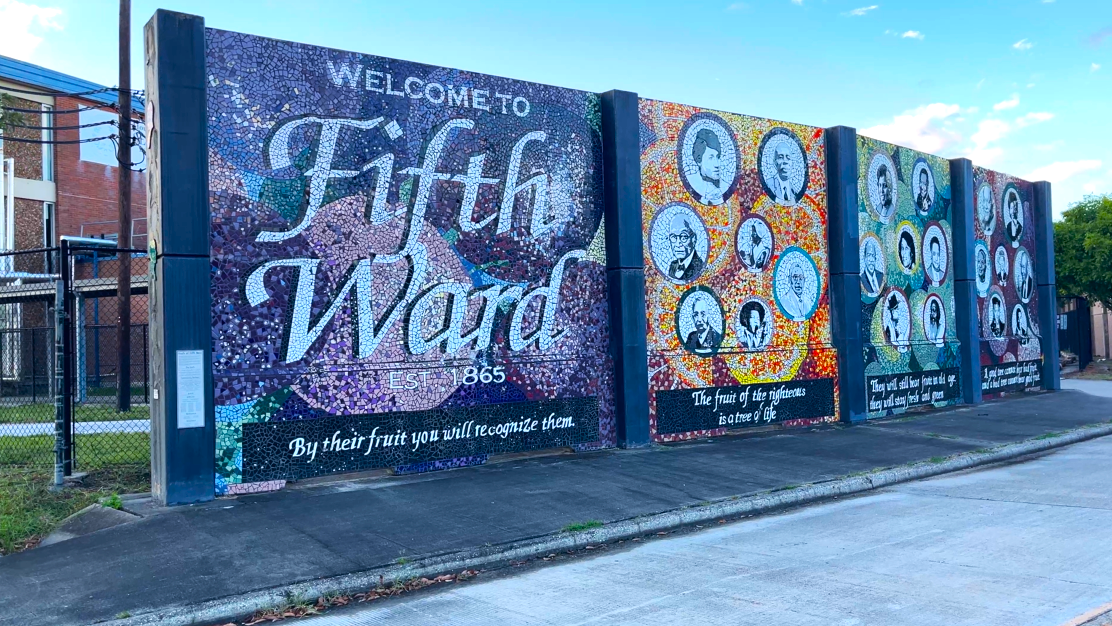
Kathy Blueford-Daniels, former president of Greater Fifth Ward SN 55, credits SN engagement for bringing attention to concerns about creosote contamination near Union Pacific’s railyard. She helped raise the issue with the late Congresswoman Sheila Jackson Lee and State Sen. Boris Miles, sparking community meetings and regulatory scrutiny.
“The engagement of the SN is very, very important,” said Blueford-Daniels, a current Harris County Appraisal District Board member.
Fighting gentrification
For Rodgers, protecting legacy neighborhoods like Third Ward is personal.
“Nobody in the United States has defeated gentrification,” he said. “My thought process is if we can stave it off long enough, then we can maintain our flavor here in Third Ward.”
Watching Fourth Ward gentrify was Rodgers’ wake-up call. A trip his wife took to Tulsa, where historic Black Wall Street is now reduced to a small, two-block footprint, deepened his concern. He fears that Third Ward could one day be symbolized by only the corner where Emancipation Park and the Eldorado Ballroom intersect, with a plaque reading, “This was Third Ward.”
Resurrection and renewal
Some SNs have found new life. Sunnyside’s SN 71 went dormant around COVID but was reactivated under chair Melanie Young.
“We started getting that back set up and active around the summer of 2023… We were able to have our first meeting and get approved by the city of Houston in March of 2024,” Young said.
A millennial born and raised in Sunnyside/South Park, Young stepped up after noticing low participation and what she described as a “gap of understanding and communication” between residents and officials.
“They say when you notice there’s an issue, that means you’re supposed to fix it,” Young asserted.
Attendance reflects renewed energy.
“Since we started meeting in 2024, the SN meetings average about 50 people in person and maybe another 22 online,” Young said. “When there’s progress and small wins… people show back up.”
Call to participate
Bell stresses that SN work is volunteer-driven.
“The SN is there to help you protect what you have invested in for free,” said Bell. “I don’t get paid shit. I don’t get free parking. I don’t get any snacks. Ain’t no vacation. Ain’t no 401k. I don’t get a damn thing. I don’t even get a damn thank you. But it’s my passion because I love my community.”
Rodgers acknowledges participation is always a challenge.
“We’re only effective if we get your side of the coin,” he said.
Grant echoes that call.
“Gone are the days of us sitting back, complaining, and waiting for somebody to address our needs,” she said. “If your SN is hosting monthly meetings… make it to at least one.”
SN leaders agree: protecting quality of life is a shared responsibility — and a legacy worth fighting for.For more information about Houston’s SNs, visit https://www.houstontx.gov/superneighborhoods/
MORE FROM THE DEFENDER
Aswad WalkerAssociate Editor
I'm originally from Cincinnati. I'm a husband and father to six children. I'm an associate pastor for the Shrine of Black Madonna (Houston). I am a lecturer (adjunct professor) in the University of Houston...
More by Aswad Walker
Support the Defender
We can’t do this alone - help support Black media in Houston.
Your contribution is appreciated.
Sign in
Enter the code sent to your email
Email address
Enter your password
Sign in by entering the code we sent to , or clicking the magic link in the email.
Sign up for newsletters
Get the best of DefenderNetwork.com directly in your email inbox.
Sending to:
Link
Copy link
- Visit the City of Houston's Super Neighborhoods page to find your SN and its meeting schedule
- Attend at least one monthly meeting for your Super Neighborhood
- Bring a neighbor — participation is stronger when more residents show up
- Raise a specific issue at a meeting, like dumping, noise, or road problems
- Ask your SN president how to get on the agenda or connect with a city department
- Consider volunteering as a leader if your SN is inactive or needs support