What this is
Houston Grand Opera transforms familiar melodies into world-class theatrical experiences that welcome newcomers and opera lovers alike.
Image: Courtesy of Michael Bishop/Houston Grand Opera
The general public may not know The Barber of Seville specifically, but they nevertheless know it. Belt out a few “FIGAROOO! FIGAROOO! FIGARO FIGARO FIGARO FIGARO FIIIIIIIIIIGAROOOOOOO!”s and your audience will no doubt recognize the bars even if they can’t name the source.
It’s well-embedded in the pop culture canon now. Robin Williams showed off his Juilliard-trained chops in the opening scene of Mrs. Doubtfire, where he sang the iconic refrain—it’s called Largo al factotum, by the by—in the form of a cartoon canary. Sideshow Bob of The Simpsons turned the aria into a triumphant celebration of finally killing Bart, and Woody Woodpecker traded in his signature staccato laugh for a quailing stab at operatic fame by pretending to be Figaro. Now running through May 10, Houston Grand Opera’s (HGO) latest presentation of The Barber of Seville proudly and unapologetically borrows from a zeitgeist heavily inspired by composer Gioachino Rossini’s 1816 comedic opera.
Image: Courtesy of Michael Bishop/Houston Grand Opera
Look, he’s essentially Bugs Bunny. There’s really no other way to put it.
The G.O.A.T.
04/20/2026
By Elisabeth Carroll Parks
Read full text
The cycle creates something of an ouroboros effect, and one necessary for art to thrive. HGO delivers a fun, engaging, and thoughtful presentation that makes for a familiar entry point to opera as a whole. For those looking to learn more about the art form, this production’s classical music, themes, and archetypal characters provide a simple, easy-to-follow story, even for those who don’t speak Italian (don’t worry, though—HGO runs supertitles that translate everything above the stage).
“People do know opera," HGO president Khori Dastoor says. "They’ve heard it. They’ve lived with it… There’s just these themes that are ubiquitous in our culture, and people don’t even know they’re listening to opera. And that’s the fun part sometimes, of welcoming new audiences." That's where HGO comes in. “It’s really important that we educate the public on not only what they don’t know, but what they do know. And what you find is that these works are really broad in their appeal."
This season’s The Barber of Seville embraces the aforementioned broadness of Rossini’s original opera buffa (a genre of Italian comic opera that originated in Naples) while incorporating elements from other broadly appealing art forms, including animation, Cubism, musical theater, and Vaudevillian slapstick.
In the introduction, Count Almaviva, played by tenor Jack Swanson, serenades his lady love, Rosina (mezzo-soprano Daniela Mack), while standing atop a giant, candy-colored, heavily stylized guitar; one wonders whether his diaphragmatic strength or his sense of balance is more impressive. Asymmetry and unusual forms permeate the setting, including Rosina’s stiff-skirted dress, doorways, and the exaggerated pink piano that doubles as a desk, stage, and—in one hilariously memorable moment—a visual homage to Andrew Lloyd Webber’s Phantom of the Opera.
The inherent cartoonishness shines through in little touches like the villainous Dr. Bartolo (baritone Alessandro Corbelli) sporting a frightfully green hairstyle that would fit right in with the cast of Bozo’s Circus. Or the silent Greek chorus of his servants, who play out tableaux, either mirroring or adding texture to the scene. They puppet and strip one of their own to his modest undergarments as the nefarious doctor and his henchman, Don Basilio (bass-baritone Ryan Speedo Green), plot to spread salacious rumors about the Count. Two particular servants resemble flitting cockatiels inspired by the beloved Spanish comic-book characters Zipi and Zape, according to director Joan Font. The characters get caught whitewashing a tree in the middle of Rosina’s musings, lose a hat in a thunderstorm, and get stuck on a swinging chandelier—all without peeping a single note.
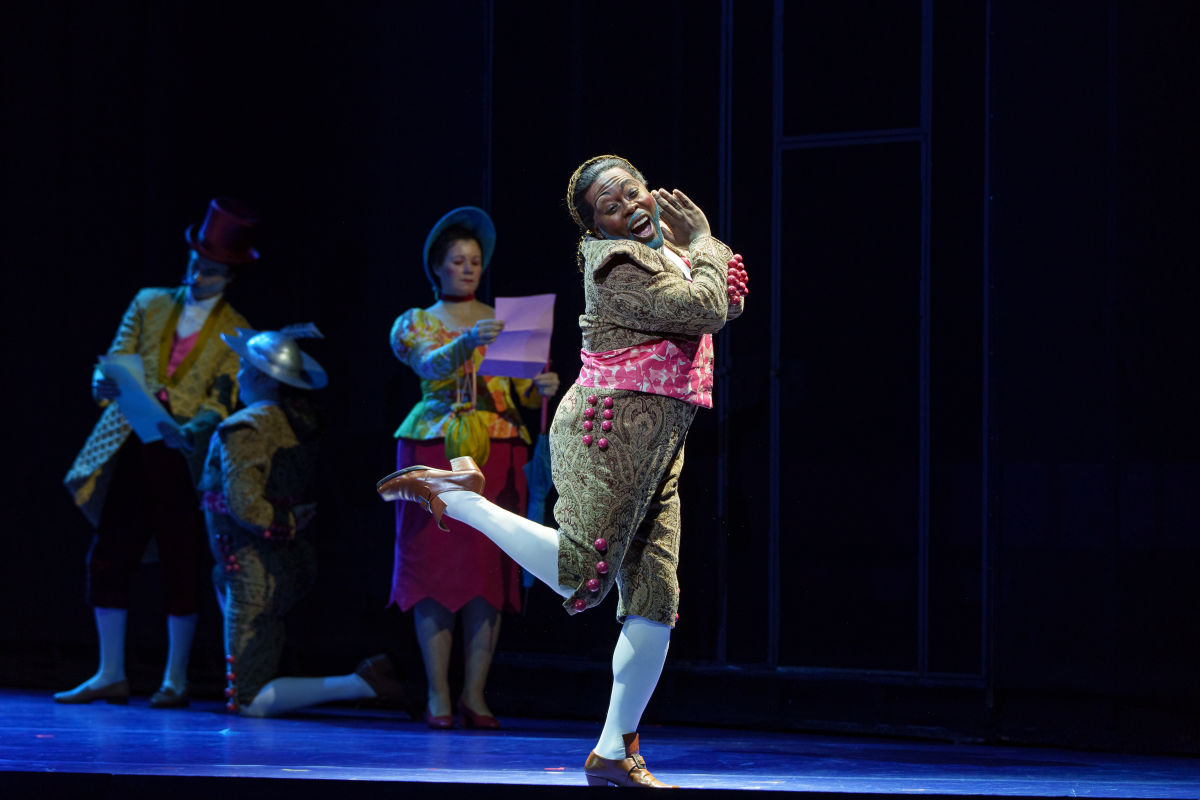
Then, there’s Figaro himself—the barber and jack-of-all-trades at the center of the chaos. Grammy-winning baritone Will Liverman clearly relishes the role, infusing him with an endearing impishness that pushes everyone around him to sillier and sillier ends.
As Liverman’s larger-than-life little stinker prances about on stage, mocking doe-eyed lovers, tricking the not-so-good doctor into kissing his arms, or designing more and more outlandish costumes to sneak the besotted Count to a trapped Rosina, it’s impossible not to immediately think of the Looney Tunes short “Rabbit of Seville.” The 1950 animated short, directed by Chuck Jones, utilizes Rossini’s prelude to The Barber of Seville as the choreography behind an extended chase between the “waskily wabbit” and hapless hunter Elmer Fudd. With silly lyrics added to a piece of music originally written without any, it’s often cited as many people’s first introduction to the opera, including members of the cast itself. “I can’t pinpoint the exact time, but I imagine that was the first time I heard [The Barber of Seville], with Bugs Bunny massaging the head of Elmer,” Mack says.
While Liverman doesn’t seduce his fellow castmates as a “much sweeter…little señoriter” or grow flowers atop a customer’s balding scalp—as delightful as that addition would’ve been—there’s a palpable throughline from the classic trickster archetype to Figaro to Bugs Bunny and back to Figaro. “I can’t tell you how many people reference Bugs Bunny to me all the time still, and these cartoons are now quite classic themselves,” Dastoor says. “I think about creating art in Houston that’s going to actually speak to the public and have resonance and relevance for us.”
Image: Courtesy of Michael Bishop/Houston Grand Opera
As director, Font makes no attempt to hide his reverence for animation. In an essay titled “Rossini: Opera’s Cartoon Composer,” audience education and communications manager Joe Cadigan mentions that assistant director and choreographer Xevi Dorca deliberately looked toward Looney Tunes and its Vaudeville roots when designing the overall look and feel of the show. He writes: “Taking cues from Rossini’s music, Dorca treats the singers like living, breathing cartoons.”
Dastoor points out that both classic animation and opera buffa evolved from the Renaissance-era commedia dell’arte tradition. Indeed, The Barber of Seville isn’t even an original story by Rossini. He penned his libretto based on a 1773 play by the playwright Pierre Beaumarchais, which was itself adapted from commedia dell’arte. The theatrical form utilizes stock characters, sometimes masked, and simplistic plots. Actors work from a script, improvise, or a combination of the two. The Barber of Seville tells a straightforward story: Man sees woman in park and falls in love. Woman is kept as a ward by a miserable old doctor who intends to marry her. Lovesick man consults local wiseguy on how to woo the woman away. Disguises and hijinks ensue until the big happy ending. Cue curtain.
Characters in commedia dell’arte usually stick to one defining trait, which they squash and stretch to create comedy or drama, depending on the story’s needs. The archetypes then subdivide based on more individualized characteristics. Count Almaviva and Rosina, for example, embody the role of innamorati (the lovers). Dr. Bartolo is a vecchio (elderly person) who can be interpreted as either a pantalone (greedy, selfish man of means) or an il dottore (snobbish doctor). Figaro himself is a zanni (servant) figure—either a harlequin (witty yet reckless trickster) or brighella (clever liar with a slapstick bent). Even those unfamiliar with commedia dell’arte can still recognize these characters. They form the basis for much of European and American entertainment, creating the scaffolding for theater, opera, comedy, and the very cartoons HGO seeks to channel. “We don’t take ourselves seriously when it comes to the audience having to mind the rules, but we take the preparation and the craft of [opera] incredibly seriously,” Dastoor says.
Image: Courtesy of Michael Bishop/Houston Grand Opera
In this, the opera company breaks down outdated notions of what constitutes the highbrow, the middlebrow, and the lowbrow, all of which were originally based on racist phrenological pseudoscience. There is, at the end of the day, only ever art. Commedia dell’arte begat The Barber of Seville, which begat Bugs Bunny, who then turned around to beget The Barber of Seville once more.
The snake makes a delicious meal of its own tail in an endless loop of inspiration and information, where different media overlap to find new and novel ways to present established narratives. To dismiss animation as “low” and opera as “high” is to dismiss the potential for creative innovation. Blending the two, be it on screen or stage, can even serve as an entry point to art previously misconceived as too difficult to grasp. “Opera has this stigma…like an aura of inaccessibility, sometimes, especially if you’ve never been,” Mack says. “Pieces like [The Barber of Seville] really have the potential to break that apart and say, 'No, actually, you can enjoy this music. This music is for anybody.'”
Ever Wonder Why
03/12/2026
By Erica Cheng
Houston Collects
04/06/2026
By Meredith Nudo
Outliers
01/22/2024
By Jef Rouner
Key details
- Current Show: The Barber of Seville through May 10
- Location: Wortham Theater Center, downtown Houston
- Accessibility: Supertitles translate everything, no experience needed
- Community Impact: Education programs for students and families
- Reading time: 2 minutes
Where it reaches
- Address
- 1773 play by the pl
- Phone
- 713-862-4570
Available across Houston.
Why it matters
Houston Grand Opera makes world-class theater accessible to everyone in our city. You'll hear songs you already know from movies and TV, but see where they really came from. It's affordable culture that brings our community together downtown.
How to dig in
- 1Start with the snapshot above to know what this is in a glance.
- 2Read through to understand how it connects to the bigger picture.
- 3Open it using the button above.
When you call, you can say: “Hi, I saw "Houston Grand Opera Brings Classic Stories to Life" on Community Exchange and want to know how to take part.”
By the numbers
Led byHoustonia Magazine
Counted from the Community Exchange connection graph.